

Processing heavy glass sheets — typically those exceeding 12 mm in thickness — places extraordinary demands on cutting table engineering. Conventional roller or felt-lined supports risk surface damage, edge chipping, and dimensional deviation under concentrated load. Air-float cutting tables solve these problems by lifting the sheet on a thin, uniform film of pressurized air, eliminating direct contact and enabling smooth positioning along the cutting axis. However, achieving reliable floatation and cutting accuracy with heavy formats requires a fundamentally different level of design rigor. This article examines the key optimization parameters, from plenum geometry to pressure control, and explains how DISAI engineers these systems for demanding production environments.
Why Standard Air-Float Configurations Struggle with Heavy Sheets
A standard air-float table designed for thinner glass maintains a modest air gap with relatively low plenum pressure. When the same table is loaded with a 19 mm jumbo sheet weighing well over half a ton, the outcome changes dramatically. The air film becomes uneven, portions of the sheet settle onto the table surface, and the resulting friction makes precise scoring strokes virtually impossible. Even a small reduction in the air gap cannot be tolerated in heavy-sheet work, because contact pressure rises non-linearly as the gap closes.
Compounding the issue is structural deflection of the table frame itself. Under heavy load, a lightly reinforced table may bow enough to create high and low zones across the cutting area. The air film cannot compensate for a non-flat support surface. For this reason, heavy-sheet optimization must address the pneumatic system and the mechanical substructure simultaneously.
Core Optimization Parameters for Heavy-Sheet Air-Float Tables
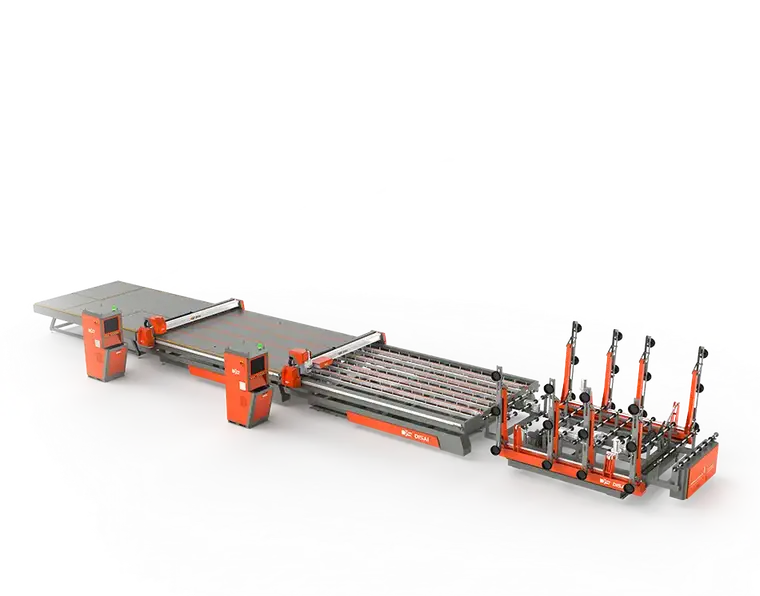
Optimization is not a single adjustment but a coordinated set of engineering decisions. The following parameters determine whether a table can handle heavy glass while maintaining cutting accuracy at production speed.
Plenum Chamber Design and Internal Air Distribution
The plenum — the sealed chamber beneath the table top — must deliver equal pressure to every nozzle across the working area. In a heavy-sheet table, air consumption is considerably higher because more mass must be supported per unit area. If the plenum is too shallow or the inlet ports are undersized, pressure differentials develop between the center and the perimeter, causing the sheet to hover unevenly.
For heavy formats, engineers should increase plenum depth, enlarge inlet cross-sections, and position multiple feed points symmetrically. DISAI applies computational flow analysis to balance these channels, ensuring that pressure variation across the entire cutting surface remains well within tight tolerances.
Nozzle Density and Orifice Geometry
The individual air nozzles determine the stiffness of the air film — its ability to resist thickness reduction under load. A higher number of smaller-diameter nozzles provides greater film stiffness than fewer, larger nozzles at the same total flow rate. Heavy sheets require this increased stiffness to prevent localized sagging between adjacent nozzles.
Additionally, the entry edge of each orifice should be radiused to reduce turbulence and flow restriction. Sharp-edged drilled holes create micro-jet effects that lead to pressure noise and uneven lift. Precision machining of every orifice is a small detail with an outsized effect on cutting-line quality.
Table Top Flatness and Frame Rigidity
No air system can overcome a bowed table. The support surface must maintain flatness within a strict tolerance under full rated load. This requires a welded steel frame that is stress-relieved after fabrication, with sufficient section depth to resist bending moments from heavy sheets.
For very large tables — over six meters in length — DISAI employs twin-beam frame construction and additional transverse stiffening ribs, keeping deflection under load within specification. This mechanical foundation is the precondition for effective pneumatic performance.
Air Supply and Pressure Control Strategy
Heavy-sheet cutting tables must not only provide higher pressure but also respond to changing load conditions. As the cutting head traverses the sheet, mass distribution over the air film shifts, particularly when pieces are separated and removed from the table.
Closed-Loop Pressure Regulation
A fixed-pressure system wastes energy and can cause the sheet to float too high when load is removed, creating instability during cutting. Modern optimization uses closed-loop pressure control: sensors in the plenum feed signals to a regulator, which adjusts air supply continuously to maintain a constant floating height regardless of sheet weight.
Zone-Based Air Management
In large tables, dividing the plenum into independently controlled zones is often advantageous. If a heavy sheet covers only half the table, the uncovered zones can be shut off, saving energy and preventing stray air currents that could disturb thin offcuts. DISAI offers zone control as an integral part of its heavy-sheet cutting table systems, enabling operators to adapt each table to mixed production patterns.
The DISAI Advantage for Heavy-Sheet Glass Cutting
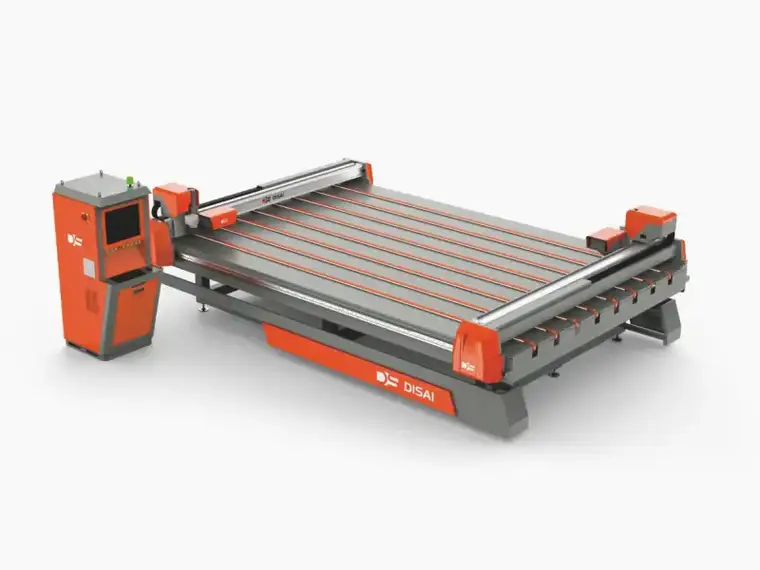
DISAI has developed a series of engineering solutions specifically for the heavy-sheet segment, serving both float-glass processors and architectural glass manufacturers. When evaluating a cutting table for heavy formats, the following capabilities distinguish a truly optimized system:
- High-stiffness air film: nozzle patterns engineered to provide uniform lift for sheets beyond 25 mm thickness, without sagging between support points.
- Stress-relieved, precision-machined top surfaces: guaranteed flatness under production load, not only in the unloaded state.
- Adaptive pressure control: automatically maintains the correct floating height as load changes during the cutting sequence.
- Integrated CNC coordination: air-float control synchronizes with the cutting bridge, preventing aerodynamic disturbances that degrade score quality.
- Energy-optimized operation: variable-speed fans and zone shut-off reduce compressed-air consumption while preserving full lifting capacity.
These features are not add-ons in the DISAI design philosophy; they are fundamental to the table architecture, ensuring that the complete system operates as a single, reliable production tool.
Selecting and Commissioning an Optimized Heavy-Sheet Table
When specifying a cutting table for heavy sheets, note that rated cutting capacity and actual floatation capacity are separate specifications. Confirm that the table's air system is rated for the maximum sheet weight you plan to process, and check the flatness tolerance specification under load, not just in an empty state.
Commissioning is equally important. Optimized performance depends on correct plenum sealing, clean air filtration, and calibration of the pressure feedback loop. DISAI provides full installation and tuning support, so your team begins production with a system performing at its designed parameters from the first day.
Conclusion
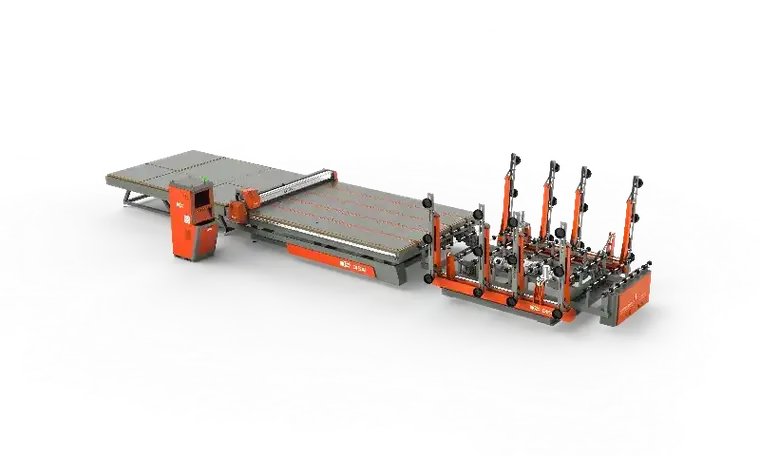
Optimizing an air-float cutting table for heavy glass sheets is a matter of disciplined engineering across three domains: the pneumatic system, the mechanical structure, and the control logic. Each must be designed for continuous operation under heavy load, because the margin between flawless cutting and scrapped glass is measured in microns. Whether you are upgrading an existing line or specifying a new installation, evaluate these parameters holistically — and work with a manufacturer who engineers them with equal depth. For production environments that demand precision on heavy formats, DISAI's optimized air-float cutting tables demonstrate what is achievable when all three domains converge.