
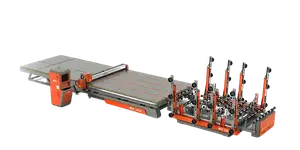

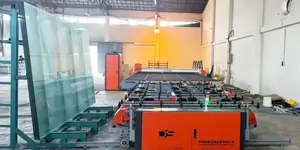
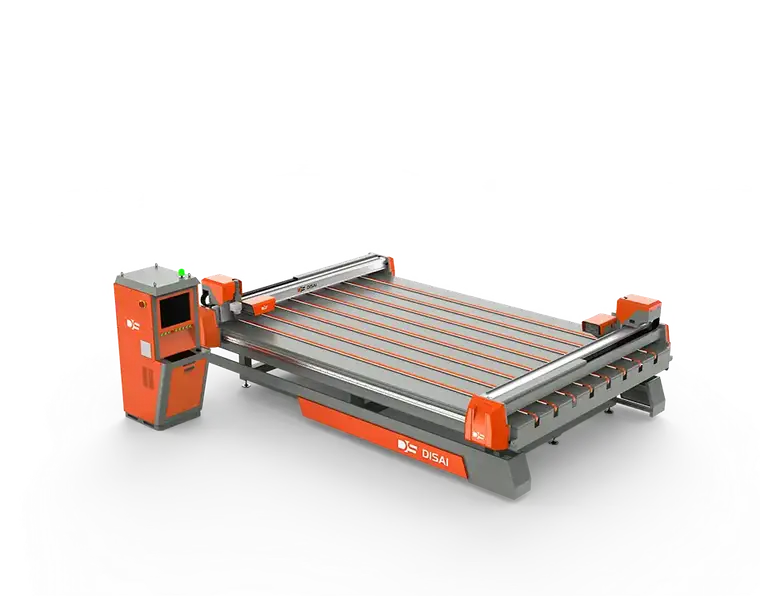
Glass cutting machines combine high-speed CNC motion, sharp carbide scoring wheels, and large sheets of fragile material. That combination creates real hazards — from flying glass fragments to pinch points and accidental contact with moving parts. For production managers and plant operators, selecting a machine with the right safety gadgets is as important as cutting accuracy. This article examines the most effective safety devices used in modern glass cutting equipment, how they protect operators, and what to look for when evaluating a purchase. We will also highlight how DISAI incorporates these systems into its glass cutting machines to meet international safety expectations.
Understanding the Hazards That Shape Safety Design
Before reviewing individual gadgets, it helps to understand what they are protecting against. A typical glass cutting machine uses an X-Y gantry system that positions a scoring head over the glass sheet. The head moves quickly and applies downward force on a tungsten carbide wheel. The main hazards include:
- Contact with the scoring head: The cutting wheel is extremely sharp, and the gantry can move without warning during automatic cycles.
- Glass fragment projection: When glass is scored and snapped, microscopic slivers can become airborne.
- Pinch points: The bridge, conveyor belts, and lifting tables create trapping zones.
- Workpiece shift: If the glass sheet is not properly secured, it can slide mid-operation, causing breakage and shard scatter.
Safety gadgets address these risks on two levels: preventing access to danger zones, and stopping motion immediately when danger is detected.
Essential Safety Gadgets on Modern Glass Cutting Machines
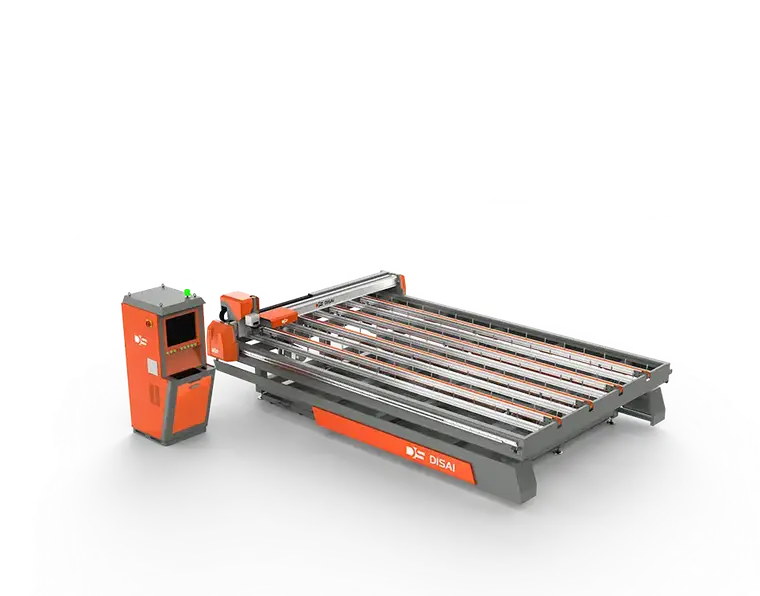
The gadgets below are not optional extras in serious industrial environments. Protective measures are required to comply with functional safety standards such as EN ISO 13849 or regional regulations.
1. Light Curtains and Area Scanners
Light curtains emit a grid of infrared beams across the loading zone. When an operator's hand or body enters the protected area, the beam is interrupted and the machine immediately halts the gantry motion. Area scanners extend this concept by mapping a protective field around the entire machine. DISAI machines support these systems as standard in many configurations, since they offer near-instant response times and are especially valuable on high-throughput cutting lines where operators frequently load and unload glass.
2. Safety Interlock Switches on Guards and Doors
Interlock switches monitor whether protective covers, safety doors, or access panels are closed. If a door is opened during operation, the switch removes power from the drive motors and brings the machine to a controlled stop. It also prevents the machine from restarting until the guard is repositioned. Look for interlock switches rated to the safety integrity level required by your application, and verify that they are installed on every access point, not only the main door.
3. Emergency Stop Pushbuttons
An e-stop is the simplest and most recognizable safety gadget, but not all e-stops are equal. Reliable designs use redundant contacts monitored by a safety PLC, so a single stuck contact cannot defeat the system. DISAI places multiple mushroom-style e-stop buttons along the machine perimeter so that operators can reach one from any position. The e-stop circuit should always be wired in a fail-safe manner, meaning it defaults to a stop condition if the wiring breaks. Regular functional testing of the e-stop must also be part of the maintenance schedule; a device that is never tested can silently fail at the exact moment it is needed.
4. Pressure-Sensitive Safety Mats
Safety mats are placed on the floor around the cutting zone. When someone steps on a mat, pressure sensors send a signal to the controller and dangerous motion stops. This is useful in areas where a light curtain could be blocked by glass racks or trolleys moving past. Mats can be segmented so that only certain zones trigger a stop, allowing material flow to continue in non-critical areas of the production line.
Electronic Safety Gadgets That Prevent Accidents Before They Happen
Mechanical and presence-detecting devices stop accidents that are already in progress. A second category of safety gadgets prevents accidents from starting by monitoring the process itself.
5. Automatic Tool Breakage and Wear Detection
A dull or broken scoring wheel changes the way glass fractures, sometimes producing uncontrolled crack propagation. This can cause sudden glass breakage and dangerous shards, and it also creates irregular cuts. Some machines monitor the acoustic signature or force profile of the scoring head. When parameters deviate from normal values, the controller pauses the cycle and alerts the operator. This is both a quality feature and a safety feature. For facilities cutting thin glass, where breakage patterns are harder to detect with the naked eye, this electronic monitoring becomes a primary safeguard rather than a convenience.
6. Vacuum and Clamping System Monitors
If the vacuum system loses suction while glass is being cut, the sheet can shift. Under the moving gantry, a shifting sheet can fracture violently. Vacuum monitoring continuously measures pressure and triggers an immediate stop when values fall below the safe threshold. It is a low-cost gadget that prevents a high-cost incident, and it also protects the glass workpiece from being ruined at the last stage of processing.
7. Software Safety Zones
Modern CNC controllers allow programmers to define digital fences that cap the movement range of the gantry or the lifting table. Even if an operator enters an incorrect coordinate, the machine will not move into a restricted zone. This reduces the risk of collision between moving parts and people, and it also protects the machine from mechanical damage caused by unintended travel.
How DISAI Integrates Safety Gadgets into Real Production Machines
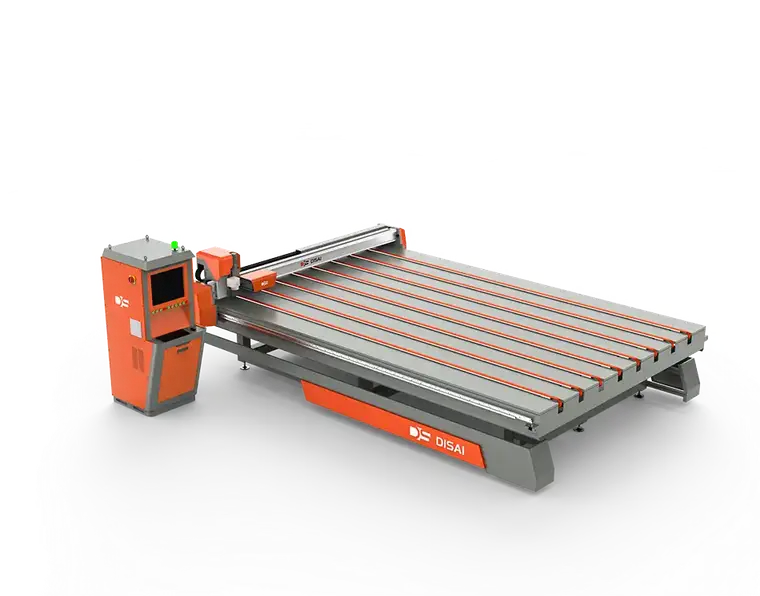
DISAI builds glass cutting machines for the architectural, automotive, and furniture glass industries. Safety is not treated as a standalone add-on at the end of the design process. Instead, DISAI integrates safety gadgets at the engineering phase:
- Standard packages include light curtains, e-stop buttons, interlocked doors, and category-rated safety relays.
- Optional configurations add safety mats, area scanners, and remote emergency monitoring.
- Layered safety logic allows the machine to continue operating at reduced speed in some regions while stopping completely in critical zones, rather than cutting all power at every alert.
This approach follows the functional safety principles of ISO 13849-1, and DISAI verifies each safety chain during factory acceptance testing. DISAI also provides operator training and detailed safety documentation with each machine, ensuring that the gadgets are not only installed but actually used correctly on the shop floor.
What to Look for When Buying a Safe Glass Cutting Machine
Safety cannot be judged from a brochure alone, but these questions help narrow the field:
- What is the Performance Level of the safety circuit? PLd or PLe rated circuits are preferable for glass cutting machinery.
- What is the stopping time? Ask for the measured safety distance calculation. Faster response means the light curtain does not need to be mounted as far from the cutting head.
- Are there redundant components? Check whether the machine uses dual-channel e-stop and interlock circuits.
- What happens when air pressure or vacuum fails? The machine should stop with the gantry in a controlled position, not drop the glass abruptly.
- Is training documentation provided? A safe machine is only safe if operators understand its gadgets and respond correctly to alarms.
Conclusion: Safety Gadgets Are a Long-Term Investment
Safety gadgets dramatically reduce the risk of injury, but they also deliver measurable business benefits. Fewer accidents mean lower insurance costs, less downtime, and higher operator confidence. In a competitive industry, a strong safety record also matters when regulators and insurance providers assess your facility. When evaluating a glass cutting machine, look beyond throughput specifications — review the safety system with the same rigor as the gantry design. A supplier like DISAI that builds safety into the machine rather than bolting it on later will give your production line a more secure future.