
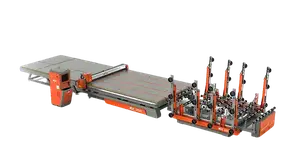

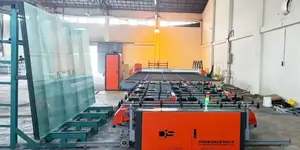
Investing in a rotary glass cutting machine is a strategic decision that directly influences production efficiency, material yield, and product quality for years to come. Unlike conventional cutting tables that rely on linear scribing, rotary cutting heads offer greater flexibility in path planning and cleaner edge scores. However, the market presents a wide range of options at substantially different price points, making it essential for buyers to understand exactly what differentiates a reliable, long-term asset from a short-term expense. This guide provides a structured framework for evaluating rotary glass cutting machines, with particular attention to the engineering standards demonstrated by DISAI, to help you make a purchase decision grounded in technical merit rather than marketing claims.
Key Specifications That Determine Cutting Performance
The technical specification sheet of a rotary glass cutting machine tells a complete story about its capability — provided you know which figures truly matter. Before engaging with suppliers, establish a clear baseline of the production parameters your facility requires.
Cutting Accuracy and Repeatability
Cutting accuracy is expressed as the deviation between the programmed cutting path and the actual scribed line. Premium machines typically achieve an accuracy of ±0.1 mm across the full cutting area.
- Positioning accuracy — the machine's ability to reach the intended coordinate point.
- Repeatability — the machine's ability to return to the same position across multiple cycles.
- Dynamic stability — how well accuracy holds during high-speed cornering and arc cuts.
Repeatability is often the more critical metric in real production because a machine that consistently produces the same dimensions enables reliable downstream processing, even if the absolute accuracy is marginally offset. Look for suppliers willing to provide a documented test report using calibrated measurement instruments.
Cutting Speed and Acceleration
Maximum cutting speed is a headline number, but acceleration figures reveal how the machine behaves in practice. A machine rated at 150 m/min maximum speed that takes several seconds to reach that speed on short straight segments will underperform a machine with superior acceleration on the intricate cutting patterns common in modern glass fabrication.
Glass Thickness Handling Range
Rotary cutting heads generate pressure through a hydraulic or pneumatic pressure-control mechanism. Verify that the machine's pressure range is documented across the full thickness spectrum you intend to cut — from 2 mm thin glass to 19 mm or thicker laminated glass — and that the cutting wheel selection corresponds to each thickness category.
Structural Rigidity and Component Quality
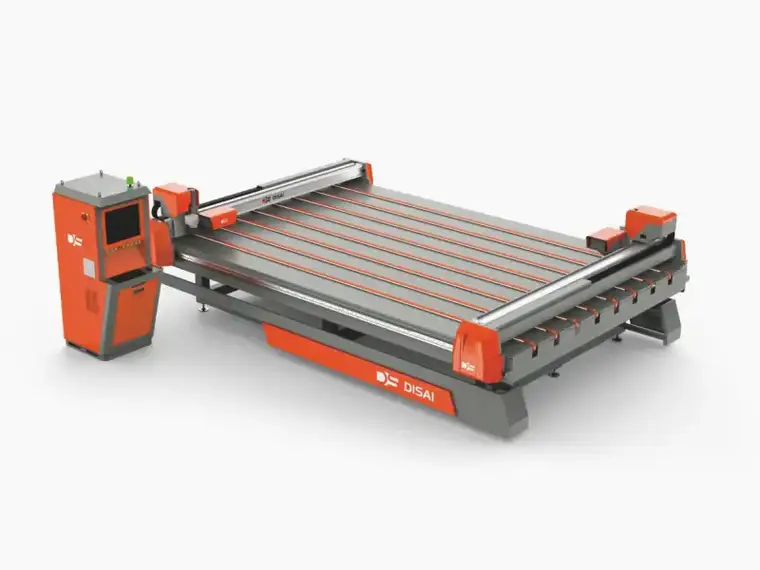
A cutting machine is only as good as its frame and motion system. The forces involved in glass scoring — even with a rotary head — produce vibration that, if uncontrolled, degrades cut quality and shortens component lifespan.
DISAI constructs its cutting tables with a heavy-duty welded steel frame that undergoes stress-relief treatment to eliminate residual deformation. This structural approach ensures the linear guide rails maintain their parallel alignment for years of continuous operation. When evaluating alternatives, ask suppliers directly about the frame's welding standards and whether stress-relief annealing is performed. Some budget manufacturers skip this step to reduce cost, leading to gradual distortion that manifests as inconsistent cut depth across the table surface.
The gantry design also deserves scrutiny. A fixed gantry with dual-drive servo motors on both ends is the engineering standard for high-precision cutting. This configuration prevents the yaw error that occurs when a single-sided drive forces one side of the gantry to lag behind the other at high acceleration.
Software Capability and Production Workflow Integration
The machine's physical performance is delivered and unlocked through its software. A rotary glass cutting machine must be able to import CAD/CAM files, automatically optimize nesting layouts, and communicate with the broader factory management system.
Nesting Efficiency and Material Yield
Advanced nesting algorithms minimize offcuts by arranging irregular shapes within a rectangular glass sheet with minimal spacing between parts. A 1 to 3 percent improvement in material yield often represents more annual savings than the machine's purchase price difference between suppliers. Inquire specifically about the nesting engine's version and its demonstrated performance on shapes similar to your typical production batch.
User Interface and Operator Training
An intuitive interface shortens the learning curve and reduces programming errors. DISAI's proprietary cutting software uses a visual, drag-and-drop interface for part placement, with real-time preview of the cutting path before the machine executes. Verify that the supplier provides comprehensive training materials, a remote diagnostic system, and software updates that reflect changing industry requirements.
Comparing DISAI with Alternative Machine Suppliers
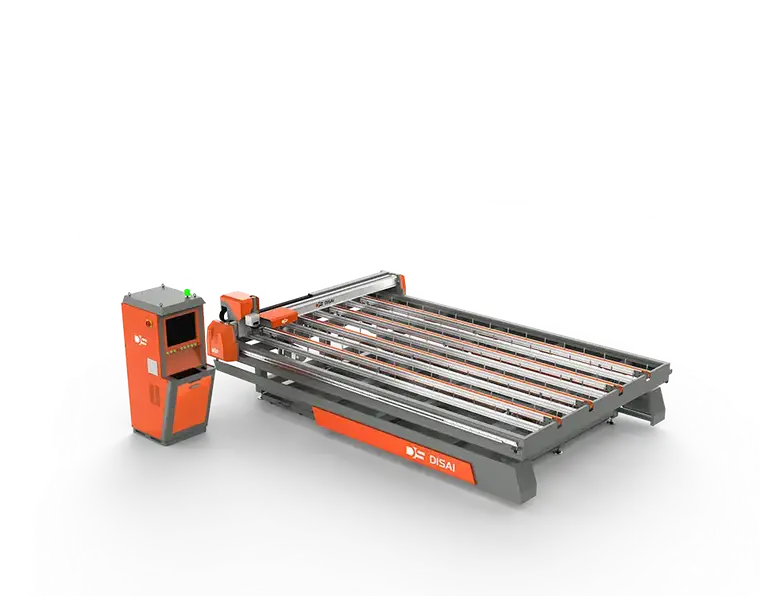
Many industrial glass machinery brands exist, but quality differs meaningfully in component sourcing, assembly discipline, and post-installation service. DISAI differentiates itself through vertical integration and a component selection strategy that prioritizes reliability over cost reduction.
- Servo drive systems — DISAI uses high-torque servo motors from established manufacturers, coupled with precision planetary reducers, ensuring smooth and accurate motion at all speeds.
- Linear guide rails and bearings — Top-grade rail systems with preloaded carriages minimize backlash and sustain high load capacity during continuous operations.
- Cutting head assembly — The rotary head features an air-bearing spindle design that reduces friction-induced heat and maintains constant rotation for uniform score pressure.
- Breakout table options — DISAI offers pneumatic or mechanical breakout systems designed to produce clean separation edges without micro-chipping, which is particularly important for thin glass.
- Carbon footprint and power consumption — Servo-driven motion and optimized acceleration profiles reduce energy consumption compared with hydraulic systems of equivalent capacity.
Before finalizing any comparison, request a side-by-side demonstration, ideally with your own glass samples and cutting patterns. A machine that performs well on standardized test pieces may reveal weaknesses under the specific geometries and material types you process.
Total Cost of Ownership Calculation
The purchase price represents only a fraction of a rotary glass cutting machine's true cost over its operational life. A rigorous total cost of ownership (TCO) analysis covers several categories that buyers frequently overlook.
Installation and Foundation Requirements
Heavy machines require a flat, level foundation. Confirm whether the supplier's quoted price includes site preparation guidance, crane or forklift help, internal logistics, and a qualified installation engineer's travel expenses. A remote or overseas installation fee can add 5 to 10 percent to the initial budget.
Consumables and Spare Parts
Cutting wheels are the primary consumable and must be periodically changed based on glass thickness and cutting distance. Ensure that replacement wheels of the required angle and quality are readily available from the supplier's local distribution network. Also compare the prices of spare parts such as air filters, guide rail wipers, and sealing gaskets.
Downtime Cost at Your Production Rate
If your production line processes 200 square meters of glass per shift, rest every 30 minutes reduces output by roughly 12 percent per shift, or nearly one shift lost per week. The cost of this downtime quickly dwarfs the initial savings from choosing a lower-priced machine. A machine supplier with a demonstrated track record of minimal failure events — such as DISAI's published preventive-maintenance schedule and remote monitoring service — offers a stronger financial guarantee than a lower invoice price.
After-Sales Support and Commissioning
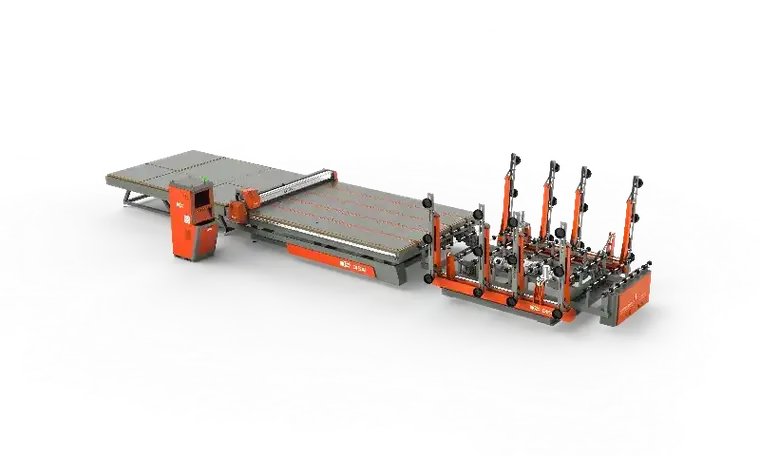
The relationship with your machine supplier begins after installation, not before. Solid after-sales support is manifest in the following areas:
- On-site commissioning — of at least three to five working days, during which the supplier's engineer works with your production staff to calibrate the machine, train operators, and troubleshoot site-specific conditions.
- Remote diagnostics — a permanent connectivity channel through which the supplier can access the machine's controller, review alarm logs, and adjust parameters without sending a technician.
- Spare parts dispatch guarantee — a written commitment that common spare parts will be shipped within a specified time frame (e.g., 24 to 48 hours).
- Structured training — covering not only basic operation but advanced nesting optimization, routine maintenance procedures, and controlled re-calibration methods.
DISAI maintains a global service network with regional response times that are confirmed at the quotation stage. Ask for the contact details of two or three existing customers in industries similar to yours, and speak with them directly about their service experience. This cost-free due diligence is the most practical validation of a supplier's promises.
Frequently Asked Questions
What is the expected lifespan of a rotary glass cutting machine?
A well-maintained machine from a reputable manufacturer typically operates effectively for 10 to 15 years or more. The structural frame and motion systems are built to long-term tolerances, while the cutting head and electronic components are considered replaceable modules that can be upgraded to extend the machine's relevance.
Can a rotary cutting machine handle laminated glass?
Yes, with the appropriate configuration. Laminated glass requires scoring both glass layers and breaking them separately, often with a dedicated break table. Confirm with the supplier that the machine's pressure control and cutting-wheel selection are calibrated for laminated-glass work, and ask about the recommended breakout procedure to prevent edge marring of the PVB interlayer.
How much floor space does a rotary glass cutting table require?
Beyond the machine's physical footprint, plan for additional clearance on all sides for material loading, glass break-out, personnel movement, and future maintenance scaffolding. A practical rule is to allocate at least 1.5 times the machine footprint as dedicated operational space, plus a storage area for racks and trolleys feeding the table.
Making the Final Purchase Decision
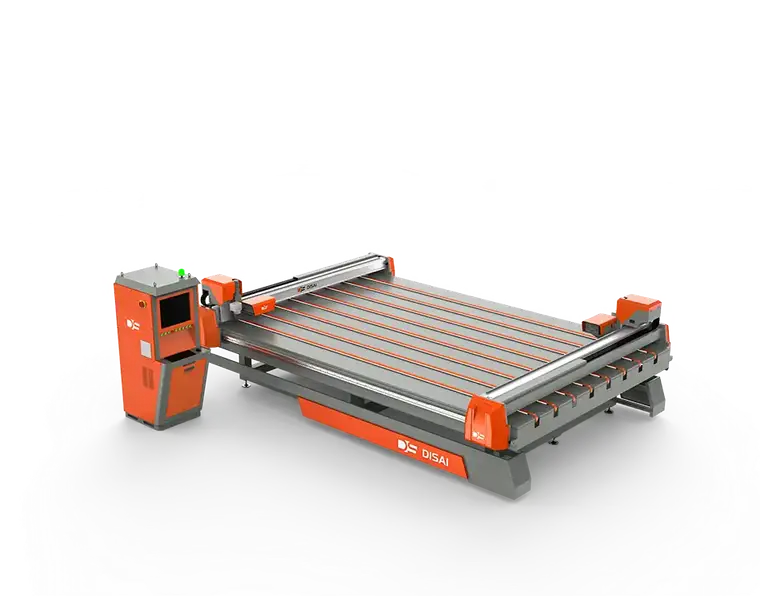
Selecting a rotary glass cutting machine is a long-term asset acquisition. The right choice will improve material utilization, reduce labor costs, and enable the reliable production of complex glass shapes that keep your facility competitive. The wrong choice — however inexpensive initially — can become a recurring source of downtime, scrap, and frustration.
Begin your process by documenting your current production volumes, typical part sizes, glass thickness range, and quality requirements. Then evaluate candidate suppliers against the engineering parameters discussed here: accuracy, acceleration, structural rigidity, software capability, component sourcing, and the depth of after-sales support. If DISAI is among the candidate suppliers, request a detailed quotation that includes a technical specifications sheet, a list of key components with their country of origin, and a term-by-term TCO breakdown. A serious supplier will welcome that level of scrutiny, and the discipline of preparing for it will sharpen your team's understanding of what the machine must deliver.
Ultimately, the machine that best fits your operation is not the one with the highest headline specifications, but the one whose combination of precision, reliability, software capability, and service commitment aligns with your production strategy for the next decade. That alignment is what separates a purchase decision from a capital investment.